I lay there on the scanning bed, half naked, again.
I’m used to this by now. Once I lay there whilst two medical students felt my breast, after the oncologist had done his examination. They need to learn what to look for after all, so by the time I was asked if it was ok with it, I just didn’t care. (Jokingly) I offered the nurse and my friend a squeeze too, just for the sheer hell of it. They declined, but honestly, whilst I hadn’t been serious, it wouldn’t have felt that odd; I had started to feel so disassociated from that part of my body. I was quite amazed by – but also possibly proud of – how much the first round of chemo and immunotherapy had shrunk the lump. Yes, it was part of me and threatened to kill me, but I could observe it from the outside as something that was extraordinary – both how fast the tumour grew before treatment and how equally fast – or faster – it had melted away with that first infusion.
Breasts can become signifiers, embodiments and harbingers of so many things across a lifetime.
Femininity – for some (for my sense of my own, at least, I think, if I’m honest).
Inclusion. Exclusion.
Sexuality. Sensation. Curviness. Motherhood. Nurturer. Feeder. (I think of ‘going bovine’ in the first weeks and months after having my son.)
Disease. Killer. Mortality.
Being part of a club I didn’t ask to join.
Aging. Warnings. Fight. Battlegrounds.
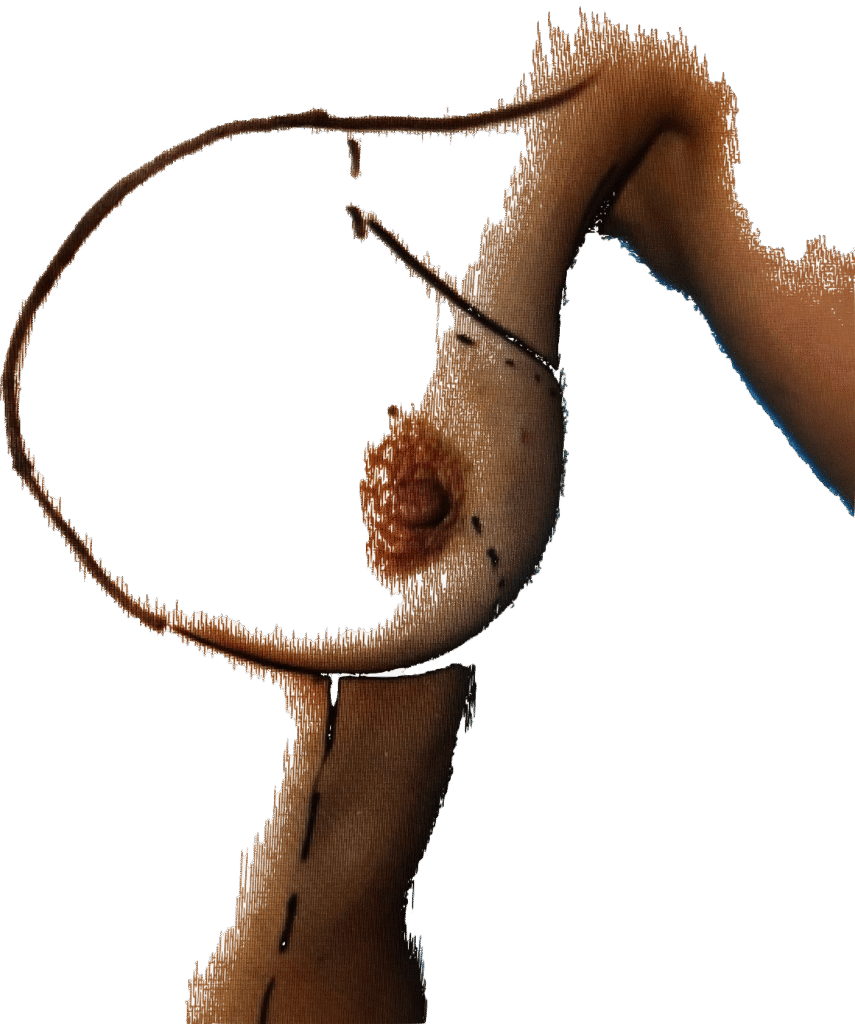
Maps.
With contours and everything.
Lying there on that bed, in the imaging room the day before my surgery, I submitted to the radiologist’s work. My body in his hands. My life – in his hands and others – perhaps. “It’s all in the planning” he said, after some time.
The focus had been intense. I had been staring, I don’t know where. I couldn’t see the screens, or didn’t try to look at them; there were at least two, perhaps three, the inside of my breast magnified on them, as he pressed the ultrasound wand into my bruised-feeling flesh, (showing patterns, like contours, which I know from previous imaging I don’t understand), getting ready to insert radioactive dye at one end of the remaining pieces of tumour and a magseed at the other. “Sorry it’s taking so long.” I think he said something like this, who knows. “The planning is the most important part.”
None of this is verbatim. I just remember the care and the focus and the intensity of the planning.
As well as the fear, always that fear; has it got bigger again? No, they insist. The chemo is still working in your biology, they say.
The next day my surgeon drew all over me. His focus took on the same intense flavour. A usually jovial, funny man, he knows how to zone in; he is holding responsibility for my life in his work, and he appreciates the aesthetics too – or perhaps the importance of them for me and my future sense of self. Struggling amidst the morning noise on the ward, he was intent, a little stressed, trying to listen through the doppler for particular blood vessels in order to mark them on my body, which he also dissected into dotted lines, mirror images, and sweeping curves. The movements of his pen were so graceful, his preparations so focussed, my breast a leaning post too as he planned the map for his operation, his artwork, complete with notes and instructions in marker pen. On my body he marked out his route and made a kind of contract between us –

I’ve got this, it felt like he was telling me through the silent concentration and the wayfinding he’d left on my skin.
I have been fascinated by this planning.
I am an improviser, not a planner, I often think. Well, I do a bit of both, of course – planning workshops and teaching sessions whilst keeping enough space for the place I come alive… improvising. I’ve thought a lot about improvisation over the years: the way that it can be seen as both transcending the absolutes – the known, the material, the prefigured – and digging into them, rooting amongst them, collecting them, reconfiguring them (the scrapyard challenge type of improvisation, discussed by Gary Peters in Philosophy of Improvisation, where the contestants have a delimited time to conjure something new from what they find).
Life is an improvisation, for me at least. I love the emergence, the seeing what happens, the going off-piste (getting lost to find something new), the bodily decision-making that occurs in that space between knowing and impulse… the unexpected that comes after the decision to step out on a course – whether that is simply stepping off the sidelines into a performance space, or opening up a document on my laptop and seeing what unfolds, or embarking on a journey and finding places on route to stay (it feels a while since I’ve done this).
I love the pushing at the rules, the boundaries, the limitations; gently falling against them, letting them rebound,
the ping,
the momentary break and crash through,
the stretching apart,
the generative tension between choosing to obey or to rebel.
But I am fascinated by people who can really plan. I think about how in making a film you need to plan all the shots (at least usually, I imagine) – I’ve never made one and the idea of planning and envisaging everything that will unfold seems difficult to me. I’ve recently, rather randomly, stumbled across a few of Robert Rodriguez’ Ten Minute Film School videos on YouTube. Watching him talk through how he plans the shots in his films make it less mysterious to me; but I wonder if I have the fortitude, the patience… the imagination even.
I think of the aptitude that goes into planning.
The planning that must have gone into filming each episode of Adolescence in one take intrigues me: something in the series feels close to theatre, its liveness, perhaps, but to enable the rawness (of the almost improvisation) the precision planning must have been immense.
As my surgeon drew all over me, his pen was guided by underlying embodied knowledge and expertise. Later his knife too, I think.
I think about how there is a kind of expertise in not knowing too, in being able to sit within the unknown. Improvisation is a kind of planning to not know. I decide that in many ways, that’s where my expertise lies, across a range of different roles I take on; in being able to travel unknown routes until something emerges.
And yet, right now, I seem to have been blown off course from my unplanned route and so I reach out desperately for a plan.
When my chemo regimen got cut short by two rounds, the experts deciding that they didn’t think my battered body could cope with more at that point, I was completely thrown; we were deviating from the plan and I needed the plan to unfold as I had expected, however horrible it was. My partner said he couldn’t believe that I was literally begging for more chemo.
It often feels like I’m travelling the unknown without any control whatsoever. Well perhaps that’s an exaggeration. I haven’t given over everything; I still have agency over some aspects of my life. But it feels like the major driving force in my life right now – the cancer and its treatment – is something to which I just have to submit. And that doesn’t feel like improvisation; it feels like freefall (even whilst falling into the hands of trusted experts).
I need more control. Maybe I always have done. I am losing my strange expertise.
A friend and colleague called me one day – helping me climb out from my own despair, something that has happened on occasion, amidst the onwards energy of life that keeps moving forwards even now, through days of sofa, sunshine, appointments, distraction, moments of clarity and veils of fog – and I think now of her simple advice to just say to myself “I am ok”.
I am ok.
Those three words are sitting in the moment, in the unknown, the embodied, the present. They mean so many things. I think she meant them as a response to the anxiety, paranoia, fear, feelings of uselessness, the not knowing that I recounted to her. Three words to stop the spiralling, whatever its cause.
I think of my son and his newfound love of climbing this past year. Looking up at a crag a plan unfolds, a momentary discussion or a journey of gaps and cracks and footholds imagined, before the ascent is embarked upon. Halfway up, a suspension, a stoppage, a deviation from the plan, an improvised stretch across to another promising route. A dance between the known and the unknown.
I realise it is a score, not a plan.
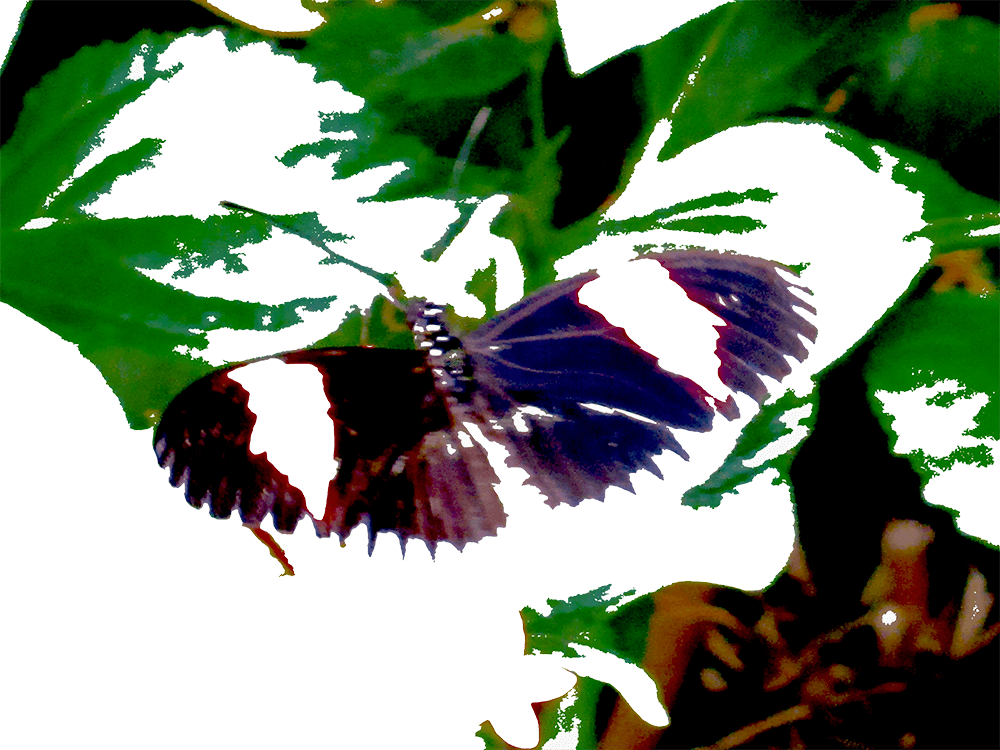
My surgeon told me recently that he tells people to think of the operation that I had in terms of a butterfly, replacing the volume they cut out from the breast – the tumour and its (hopefully) clear margins – with mirrored flesh moved from the ‘squidge’ under the arm.
A score.
A shape to imagine, to plan, to feel, to embody, to sculpt.
My flesh has moved. My breast is new. It went through a process of transformation, like a butterfly, from the imprint of a butterfly in my body.
I guess my surgeon didn’t know exactly what he would find in there when he cut the flesh open – though imaging gave him a pretty good idea and the rules, structure, limitations to guide any potential need to improvise. One way or another, it went well.
I am ok, I am ok, I am ok,
a hovering fluttering in the unknown,
slightly less comfortable in the moment,
but getting ready to fly again.